
Why Your AI SEO Strategy Is Failing: What the llms.txt Data Actually Reveals
Your AI SEO strategy may be failing due to llms.txt errors and weak credibility signals. Here's what the data actually reveals.
13 July 2026 · Updated 6 July 2026
Check whether your business and market can run ChatGPT Ads.
Most brands think they've covered AI visibility. They've updated some meta descriptions, scattered a few FAQ sections across their site, and maybe published a blog post about their AI readiness. Then they check whether ChatGPT or Perplexity actually recommends them, and they're invisible. Every time.

The gap between effort and outcome in AI SEO strategy is wider than most marketing teams realize. And the emerging data around llms.txt files and AI crawler behavior is making that gap very hard to ignore.
The llms.txt Signal Everyone Is Misreading
The llms.txt file is a relatively new standard, modeled loosely on robots.txt, that tells large language models which parts of your site are worth reading and indexing. Early adoption data is telling a clear story: most brands have either implemented it incorrectly, or haven't touched it at all.
What's going wrong? A few things, consistently:
Files that list pages without structured context, leaving AI crawlers with no signal about content priority or purpose
Brands pointing LLMs toward marketing copy rather than substantive, answerable content
No differentiation between content types, so an AI crawler treats a product landing page the same as a detailed technical guide
Complete absence of the file, meaning the AI system is left to guess (and it often guesses wrong)
The honest counterargument here is fair: llms.txt is still an emerging standard, and not every major AI system has formally committed to following it. That's true. But the brands treating it as optional are making a bet that the standard won't matter. Given the speed at which AI bot crawling behavior is maturing, that's a bet we wouldn't take.
What AI Crawlers Actually Prioritize
LLM training and real-time retrieval systems don't work like Google's crawler. They're not ranking pages based on backlink authority in the traditional sense. They're looking for clarity, credibility signals, and structured information they can synthesize into a confident answer.
When we audit client sites for AI crawler optimization, the failure patterns are remarkably consistent:
Issue | Impact on AI Visibility | How Common |
|---|---|---|
No llms.txt file present | AI systems lack crawl guidance | Very common |
Content without clear entity signals | Brand not recognized as authoritative source | Extremely common |
Thin or vague product descriptions | AI skips the page in favor of clearer sources | Common |
Missing structured data markup | Context lost during AI processing | Very common |
No third-party credibility signals | LLM treats brand as unverified | Common |
The brands showing up in AI-generated recommendations have addressed most of these. The ones that haven't are watching their competitors get cited instead.
Why "Good Enough" Traditional SEO Doesn't Transfer
There's a reasonable assumption that if your traditional SEO is solid, your AI visibility will follow. The data doesn't support this. A brand can rank on page one of Google and still be completely absent from ChatGPT or Gemini responses on the same topic.
The mechanics are genuinely different. Traditional search rewards signals like domain authority, keyword density patterns, and click-through rates. LLMs reward something closer to trustworthiness and specificity. They want to know: does this source answer the question cleanly, and is there external evidence it's credible?
AI adoption is accelerating fast enough that this distinction matters now, not in two years. The global AI market continues to expand at a pace that makes early positioning genuinely valuable. The brands building AI visibility infrastructure today are establishing citation patterns that later entrants will struggle to displace.
The Content Structure Problem
One of the most underappreciated issues is how content is *structured*, not just what it says. LLMs parse content differently than human readers. Dense paragraphs of marketing prose, no matter how well-written, don't give an AI system the clear, extractable answers it needs to confidently recommend your brand.
What actually works:
Direct question-and-answer formatting within content pages
Clear entity definitions (who you are, what you do, who you serve)
Specific claims backed by data, not vague benefit statements
Consistent brand mentions across third-party sources that AI systems can cross-reference
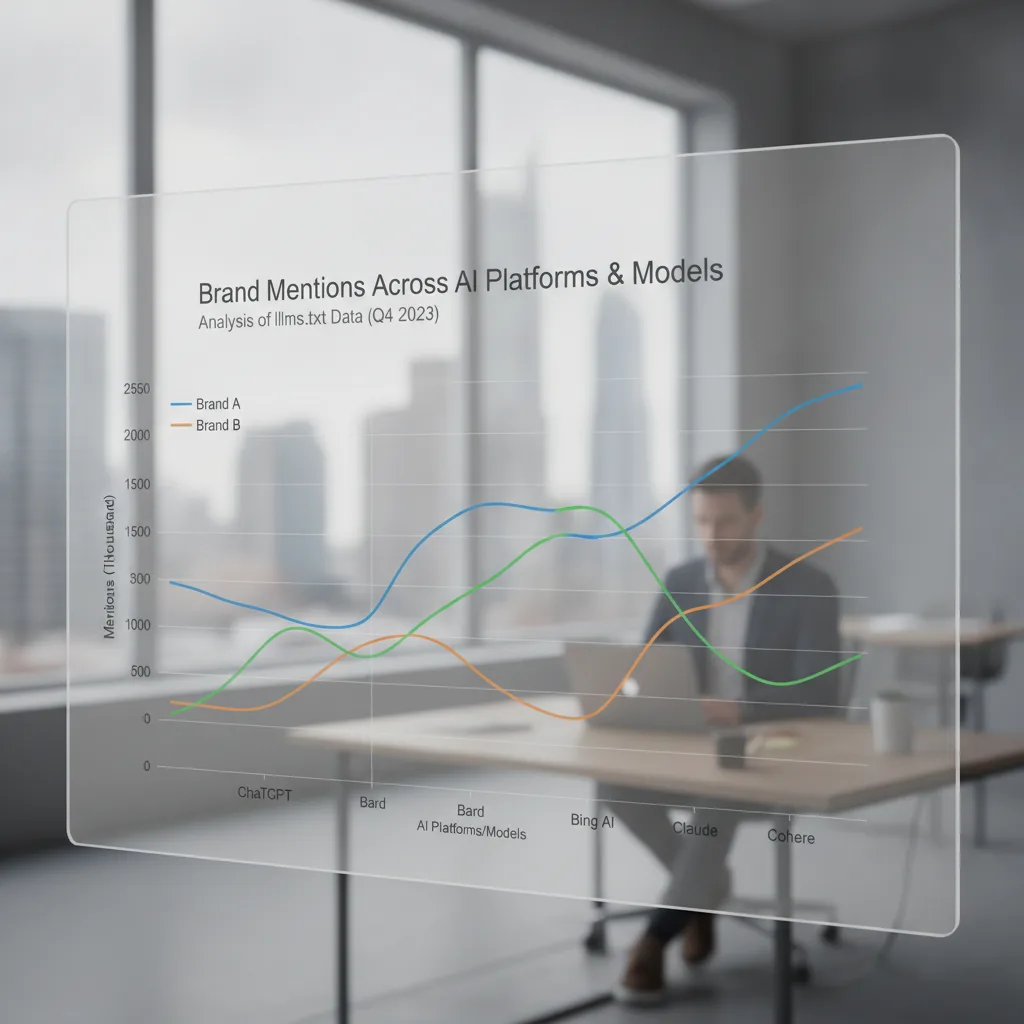
The client results we've documented at Index Lab consistently show that restructuring content for LLM readability drives faster visibility gains than any amount of traditional optimization. A 61% increase in brand mentions across AI platforms doesn't happen by accident. It happens because the underlying content architecture gives AI systems something concrete to work with.
Credibility Signals LLMs Can Actually Verify
This is where most AI SEO strategies fall apart quietly. Brands focus entirely on their own site while ignoring the external credibility ecosystem that LLMs rely on to validate sources.
AI systems are trained on broad corpora of web content. If your brand is mentioned substantively in industry publications, review platforms, professional directories, and relevant forums, that cross-referencing strengthens the signal. If you only exist on your own domain, the model has limited evidence to work with.
Research from McKinsey's AI research has highlighted how AI adoption is reshaping business operations globally, and the credibility infrastructure question sits at the center of that shift. Brands that have built genuine third-party presence are better positioned for the AI discovery era regardless of which specific LLM dominates.
What a Functioning AI SEO Strategy Actually Looks Like
Let's be direct about what separates strategies that work from those that don't. The difference isn't effort. It's sequencing and specificity.
Brands that achieve measurable AI visibility gains tend to follow a consistent pattern. They start with technical foundations (llms.txt, structured data, site architecture), move to content restructuring for LLM readability, build external credibility signals systematically, and then monitor for mention patterns across platforms. Skipping any of these phases means the others underperform.
The Accenture research on AI investment underscores a broader point: organizations that approach AI strategically rather than reactively see meaningfully better outcomes. The same principle applies directly to AI visibility. Reactive patching (adding an llms.txt file after months of ignoring it) rarely catches up to brands that built the foundation properly from the start.
One counterpoint worth acknowledging: some teams argue that AI-sourced traffic is still too small a channel to prioritize over proven acquisition methods. That's a legitimate position for brands in very specific situations. But conversion data complicates this argument. Traffic arriving from AI recommendations converts at roughly twice the rate of traditional search traffic in our client base. The volume is lower today, but the quality signal is strong enough to take seriously.
The evolving conversation around content and AI tools at Content Marketing Institute reflects a broader industry reckoning: content created without LLM discoverability in mind is becoming a structural liability, not just a missed opportunity.
Where This Goes Next
AI search behavior will keep fragmenting. Perplexity, ChatGPT, Gemini, Claude and whatever platforms emerge next all have somewhat different retrieval architectures. Brands that build for the underlying principles (clarity, credibility, structured content, external validation) will hold their position across platform shifts better than those optimizing for any single system.
The Deloitte research on global AI investment patterns points clearly toward sustained acceleration across markets, not just in North America and Europe but across Asia-Pacific and emerging markets too. AI-driven discovery is a global shift. Brands that treat it as a local or niche trend are misreading where their customers are actually going.
The llms.txt data isn't just a technical curiosity. It's a mirror. And for most brands, the reflection reveals an AI SEO strategy that looks busy on the surface while missing the structural elements that actually drive recommendations.
If you want to understand where your brand actually stands in AI-driven discovery, the Index Lab team focuses exclusively on this problem. Or if you're ready to move past the audit stage, reach out directly and we'll show you what a properly sequenced AI visibility build looks like in practice.
See which brands ChatGPT names when your buyers ask their questions.
Explore with AI
[ Keep exploring ]
Terms in this article
[ Related reading ]
GPT-6 turns ChatGPT answers into interfaces with charts, buttons and forms
OpenAI's Intelligent UI replaces plain text with side-by-side comparisons, interactive charts and small in-chat tools. The source says nothing yet about where the content in those layouts comes from.
Read →NewsAI Overviews now appear on over 80% of branded searches, with no announcement from Google
DemandSphere and Ahrefs both put the rate above 80% at the end of September. Their figures, as reported, count whether the AI Overview appears. They do not say whether your brand is in it.
Read →NewsOpenAI puts paid display ads next to ChatGPT image generation results
OpenAI will test ads beside ChatGPT image generation for Free and Go users in the US from later in October. The same announcement named its measurement partners and opened Negative Phrases to qualifying advertisers.
Read →See where your brand stands in AI.
Free visibility check →