Bing's New AI Performance Data: What It Means for Your Brand's AI Visibility
AI performance reporting tools from Bing now show brands how often they appear in AI responses, here's how to use that data to improve your AI visibility.
Guilherme Hortinha · 13 July 2026
Want to know if your business can run ChatGPT Ads? Check here.
For years, marketers have operated on a simple feedback loop: publish content, check rankings, adjust. Google Search Console told you where you stood. Now that loop is breaking. More of your potential customers are skipping the search results page entirely and asking an AI assistant for a recommendation instead. The question is no longer just "do we rank?" It's "do we get mentioned?"
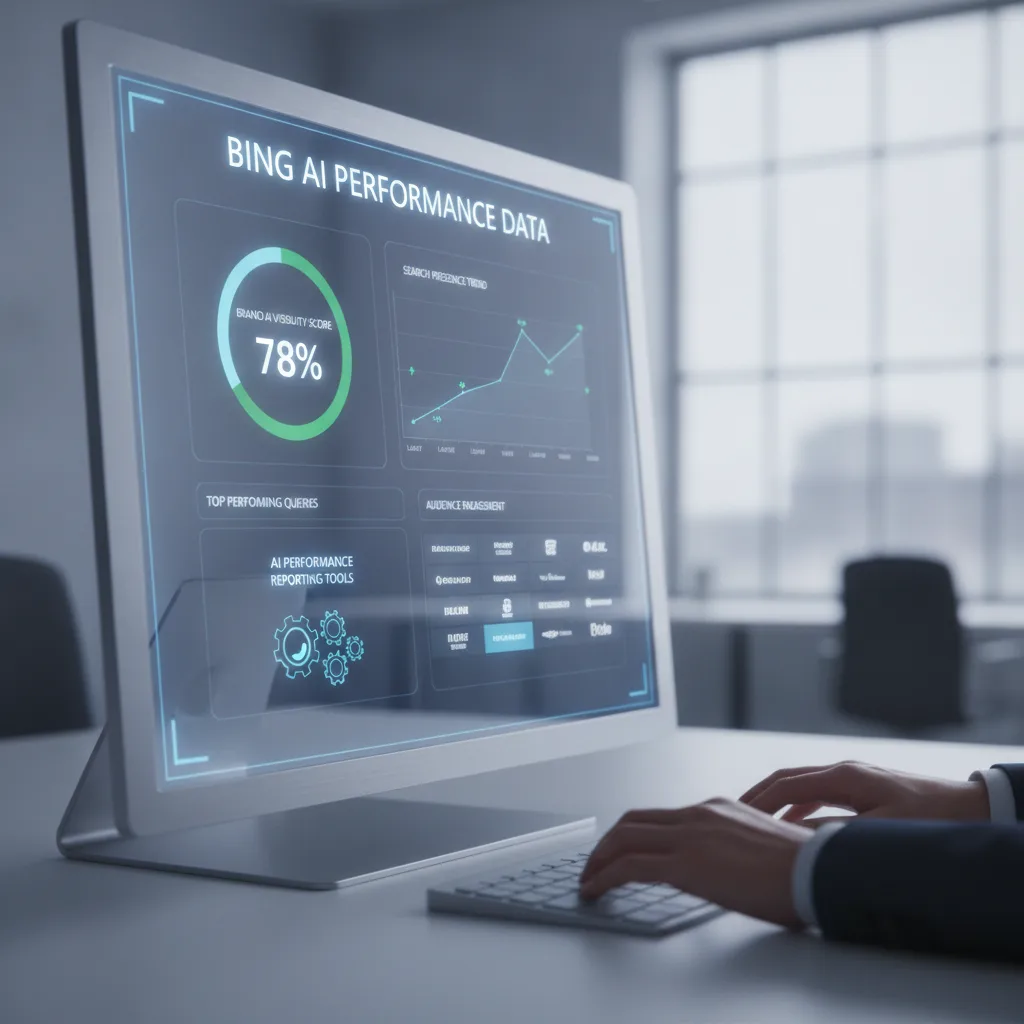
Bing is starting to answer that question with actual data. Their expanded AI performance reporting capabilities inside Bing Webmaster Tools represent something genuinely significant: the first time a major platform has given brands structured visibility into how they appear inside AI-generated responses. If you're serious about brand visibility in AI-driven channels, this development deserves your attention.
What Bing Is Actually Reporting (And Why It's Different)
Traditional search analytics track clicks, impressions, and position. You can see exactly how often your page appeared for a given query and how often someone clicked through. AI-generated responses don't work that way. When Copilot or another AI model surfaces your brand in a conversational answer, there may be no click at all. The user gets their answer and moves on. Traditional metrics miss this entirely.
Bing's new reporting approach attempts to bridge that gap. The platform is surfacing data that maps closer to citation share in SEO contexts: how often your brand or content is referenced within AI-generated answers, across which query categories, and with what frequency relative to competitors in your space.
The Metrics That Actually Matter
Not all of the signals Bing is exposing are equally useful. Here's how we'd categorize them for practical use:
Metric Type | What It Measures | Business Relevance |
|---|---|---|
AI Impression Share | How often your brand appears in AI responses for tracked queries | High: directly signals AI discoverability |
Citation Frequency | Number of times your content is referenced as a source | High: indicates content authority with LLMs |
Query Category Coverage | Which topic clusters trigger your brand mentions | Medium: useful for content gap analysis |
Competitor Citation Gap | How your citation share compares to rivals | High: prioritizes optimization effort |
A Fair Counterargument
Some marketers will push back here, and reasonably so. Bing's share of the overall AI search landscape is smaller than Google's or ChatGPT's. If you're optimizing purely for volume, the argument goes, why prioritize Bing's data?
The answer is pragmatic: Bing is currently the only platform offering this level of structured AI performance reporting. The data isn't perfect and the sample size isn't the whole market. But it's *real signal* in a space that has operated almost entirely on guesswork until now. Brands that learn to read these metrics now will be better positioned when Google and other platforms inevitably follow with their own reporting frameworks. Early movers in data literacy almost always win the optimization game.
How to Use This Data to Improve Your AI SEO Optimization
Raw data without a framework for action is just noise. The brands that will benefit most from Bing's new capabilities are the ones that treat this as an input to a broader AI SEO optimization strategy, not a standalone vanity metric to screenshot and put in a deck.
Start With Citation Gap Analysis
Pull your query category data and identify where competitors are being cited and you're not. This isn't unlike traditional gap analysis for keywords, but the intent is different. You're not looking for ranking opportunities. You're looking for topics where an AI model is forming opinions about your category and your brand isn't part of the conversation.
For most brands, the gaps cluster in a few predictable areas:
Definitional or educational queries where your brand lacks structured, citable content
Comparison queries where third-party sources are being referenced instead of your own materials
Use-case queries where your product solves a problem but your content doesn't clearly connect the dots
Our team at Index Lab works through exactly this kind of analysis with clients. The pattern we see consistently is that brands with strong traditional SEO still have significant blind spots in how large language models understand and represent them.

Treat Bing Webmaster Tools as Your AI Performance Baseline
Before Bing's reporting update, most brands had no baseline for AI visibility at all. Now you do, at least for one major AI-powered surface. Set that baseline immediately. Document your current citation share, your query category coverage, and which competitors are outpacing you in AI mentions. Then run your optimization work and measure the delta.
This mirrors how we've always thought about AI SEO tools and frameworks: the goal isn't to chase a platform's algorithm, it's to give AI systems the structured, credible, contextual information they need to represent your brand accurately. Bing's data now lets you verify whether that work is actually translating into mentions.
Credibility Signals Still Drive Citation Share
One thing Bing's data consistently reinforces: brands with stronger third-party credibility signals earn more citations. This tracks with how large language models are trained. As the Content Marketing Institute has explored, AI tools are reshaping how content authority is built and distributed. Being cited by authoritative external sources, having consistent structured data, and maintaining clear entity definitions all influence how often an AI model reaches for your brand when constructing an answer.
The AI investment landscape is accelerating this urgency. Global AI market projections from Statista point to continued rapid adoption across industries and geographies, which means the share of customer discovery happening through AI channels will only grow. Waiting to engage with AI performance data is a choice to fall behind.
What Comes Next for AI Performance Reporting
Bing's move is a signal, not a destination. We expect the broader AI search ecosystem to develop more sophisticated performance reporting over the next 12 to 24 months. Here's where we think this is heading:
Cross-Platform Citation Tracking
Right now, there's no unified tool that tells you how your brand performs across ChatGPT, Gemini, Perplexity, and Copilot simultaneously. That gap will close. Third-party AI performance reporting tools are already emerging to fill this space, and platform-native reporting will become more granular as the commercial stakes rise. The brands building internal processes around Bing's current data will adapt to those tools faster. To understand how the ChatGPT and AI search ecosystem is evolving, the reporting infrastructure matters as much as the optimization tactics themselves.
Attribution Models Will Catch Up
The thorniest problem in AI visibility right now is attribution. When a customer asks Gemini for a software recommendation, gets your brand's name, and converts two days later through a direct visit, that conversion looks organic in your analytics. It isn't. Organizations researching AI's business impact, including analysis from McKinsey's State of AI research, point to measurement gaps as one of the central challenges in realizing AI's business value. Better citation tracking is the foundation for solving that attribution problem.
AI Visibility Will Become a Board-Level Metric
This might sound premature, but consider the trajectory. Deloitte's research on AI investment shows organizations globally are increasing AI spend across functions, and customer discovery is a core commercial outcome. Once CFOs and CMOs understand that AI-sourced traffic converts at significantly higher rates than traditional channels (something our own clients have seen consistently), AI visibility will sit alongside organic search and paid media as a measured, reported, and budgeted channel.
The brands that will own that channel are the ones treating it seriously right now, when most competitors are still treating AI optimization as an experiment rather than a strategy.
Bing's new AI performance data is imperfect, limited in scope, and only one piece of a much larger puzzle. But it's *real*. And in a market where most brands still can't tell you whether AI systems even know they exist, that's a meaningful advantage worth acting on. If you want to understand how Index Lab approaches AI and answer engine optimization, this kind of measurable, data-grounded work is exactly what we do.
See which brands AI recommends when your buyers ask their questions.
Explore with AI
[ Keep exploring ]

Co-founder & Head of AI Innovation, Index Lab
Guilherme co-founded Index Lab, an AEO/GEO agency that makes brands the answer AI gives across ChatGPT, Gemini and Perplexity, taking clients from zero AI visibility to top recommendations.
[ Related reading ]
GPT-6 turns ChatGPT answers into interfaces with charts, buttons and forms
OpenAI's Intelligent UI replaces plain text with side-by-side comparisons, interactive charts and small in-chat tools. The source says nothing yet about where the content in those layouts comes from.
Read →NewsAI Overviews now appear on over 80% of branded searches, with no announcement from Google
DemandSphere and Ahrefs both put the rate above 80% at the end of September. Their figures, as reported, count whether the AI Overview appears. They do not say whether your brand is in it.
Read →NewsOpenAI puts paid display ads next to ChatGPT image generation results
OpenAI will test ads beside ChatGPT image generation for Free and Go users in the US from later in October. The same announcement named its measurement partners and opened Negative Phrases to qualifying advertisers.
Read →See where your brand stands in AI.
Free visibility check →