
OpenAI commits to a shared robots.txt signal for AI training opt-outs
OpenAI will honor a common robots.txt signal for foundational AI training preferences, built in the IETF AI Preferences working group. It has not shipped yet, and OpenAI's existing crawler controls stay in place.
Guilherme Hortinha · 30 October 2026
Can your business run ChatGPT Ads? Check in 10 seconds.
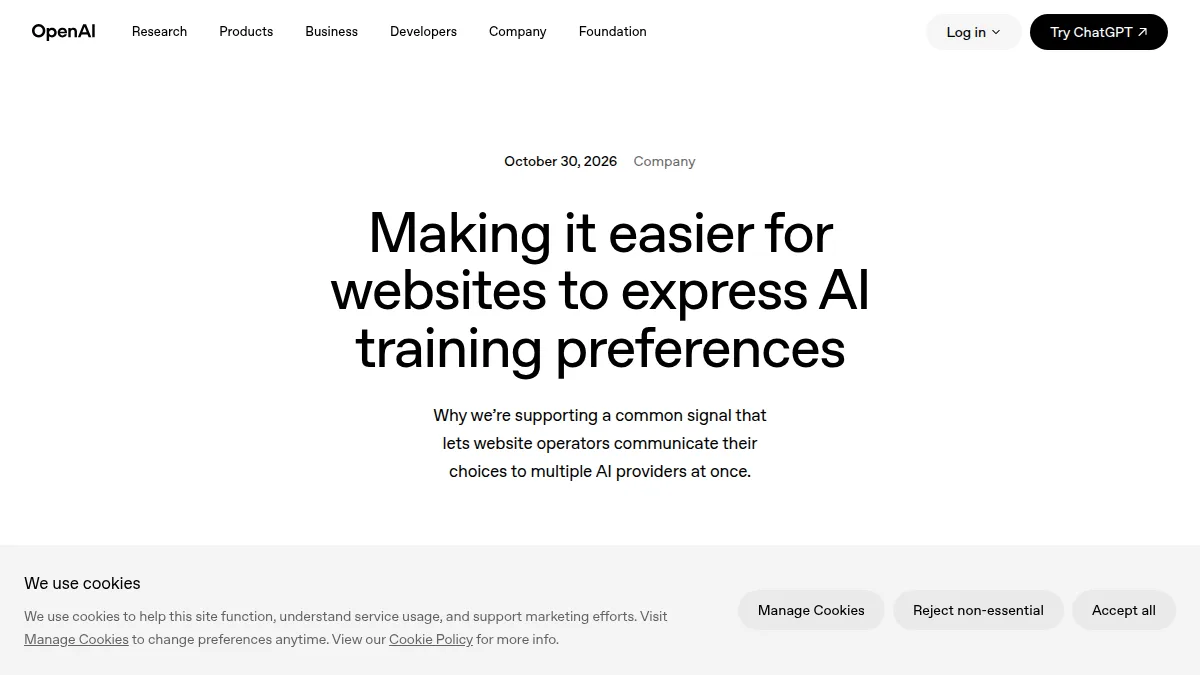
OpenAI says it will honor a common signal in robots.txt that lets a website say whether its content may be used for foundational generative AI training. In its announcement, OpenAI ties the signal to the IETF's AI Preferences working group. It says other participants in that group are announcing the same signal alongside it.
Your site works the same as it did yesterday. OpenAI says it aims to implement the signal "in the coming months" and will share implementation details when it does.
What the announcement says
The signal lives in robots.txt, the file you already use to manage crawlers.
It covers one use of your content: foundational generative AI training.
It is voluntary. OpenAI writes that it will "encourage other AI providers to honor the signal", so it only reaches providers that choose to take part.
It does not replace OpenAI's existing crawler controls, which "will continue to apply and be respected".
What it leaves open
OpenAI's post does not name the other providers taking part, and it gives no implementation date. It links to the signal but does not explain how OpenAI will read it. It also does not say what happens when the training signal and a rule for an individual crawler disagree. Until OpenAI publishes its implementation update, any answer to that is a guess.
What to do with it
The useful part is the scope. OpenAI says that until now, site operators had to identify individual crawlers and keep separate rules for every provider. One preference aimed only at training gives you a cleaner way to decline model training without touching the crawlers behind AI search and retrieval.
That separation is where brands lose visibility. A blanket block meant to keep content out of training can also stop an assistant from fetching your pages and citing them when someone asks about your category. If you want to be named in ChatGPT answers, keep the training choice and the search choice as separate decisions.
For now:
Audit robots.txt for rules that block AI crawlers wholesale, and work out which of them were only ever meant as training opt-outs.
Make the training decision as a business decision about your content, apart from your decisions on search crawlers.
Hold off on adding the new signal until OpenAI publishes its implementation details. Its post does not yet say how the signal will be read.
We will update this page when OpenAI publishes its implementation.
Frequently asked questions
Is OpenAI honoring the shared robots.txt training signal today?+
No. OpenAI says it aims to implement the signal in the coming months and will share details about its implementation when it does.
Does the new signal replace OpenAI's existing robots.txt crawler controls?+
No. OpenAI says the signal will not replace its existing crawler controls, which will continue to apply and be respected.
What does the signal cover?+
OpenAI describes it as a way for websites to state their preference on the use of their content for foundational generative AI training. It comes from the IETF AI Preferences working group.
Will opting out of training through this signal affect whether ChatGPT cites my site?+
OpenAI scopes the signal to training and does not say how it interacts with search or retrieval crawlers. Keep your training preference separate from your search crawler rules so a training opt-out does not cut off citations.
Do other AI providers honor the signal?+
OpenAI says it is joining other participants in the IETF working group in announcing the signal, but its post does not name them. It encourages other AI providers to honor the signal, and taking part is voluntary.
Which brands does ChatGPT name for your buyers' questions?
Explore with AI
[ Keep exploring ]

Co-founder & Head of AI Innovation, Index Lab
Guilherme co-founded Index Lab, an AEO/GEO agency that makes brands the answer AI gives across ChatGPT, Gemini and Perplexity, taking clients from zero AI visibility to top recommendations.
[ Related reading ]
OpenAI's Aura safety check can block ChatGPT agents from your site with no trace in your logs
A documented case shows a well-known publisher with open robots.txt rules blocked by an internal OpenAI classification, with no public reason given and no self-service review.
Read →NewsGoogle opens Gemini and Search connected apps to outside developers
Google's new Connected Apps Platform lets any U.S. developer on the waitlist submit an app that Gemini and Search can call. It does not say how the AI chooses between two apps that do the same job.
Read →NewsGoogle tests AI Mode ads shaped by Gmail and Photos data, with no new advertiser controls
A privacy policy change on October 16 lets connected Gmail, Photos and Drive content personalise ads for Personal Intelligence users. Advertisers get no new segment, bid or report.
Read →See where your brand stands in AI.
Free visibility check →