Google turns on native checkout in AI Mode and Gemini by default for Shopify merchants
Merchant Center is emailing Shopify merchants that their products can now be bought directly on Google. Nobody has to set anything up. To keep the sale on your own site, you have to switch it off in Shopify.
Guilherme Hortinha · 23 September 2026
Can your business run ChatGPT Ads? Check in 10 seconds.
Google is emailing Merchant Center users whose e-commerce platform supports the Universal Commerce Protocol (UCP) to tell them their products are now eligible for native checkout. Eligible products are included automatically. Shoppers can then buy them in AI Mode on Google Search and in Gemini, paying with Google Pay, and never visit the merchant's site.
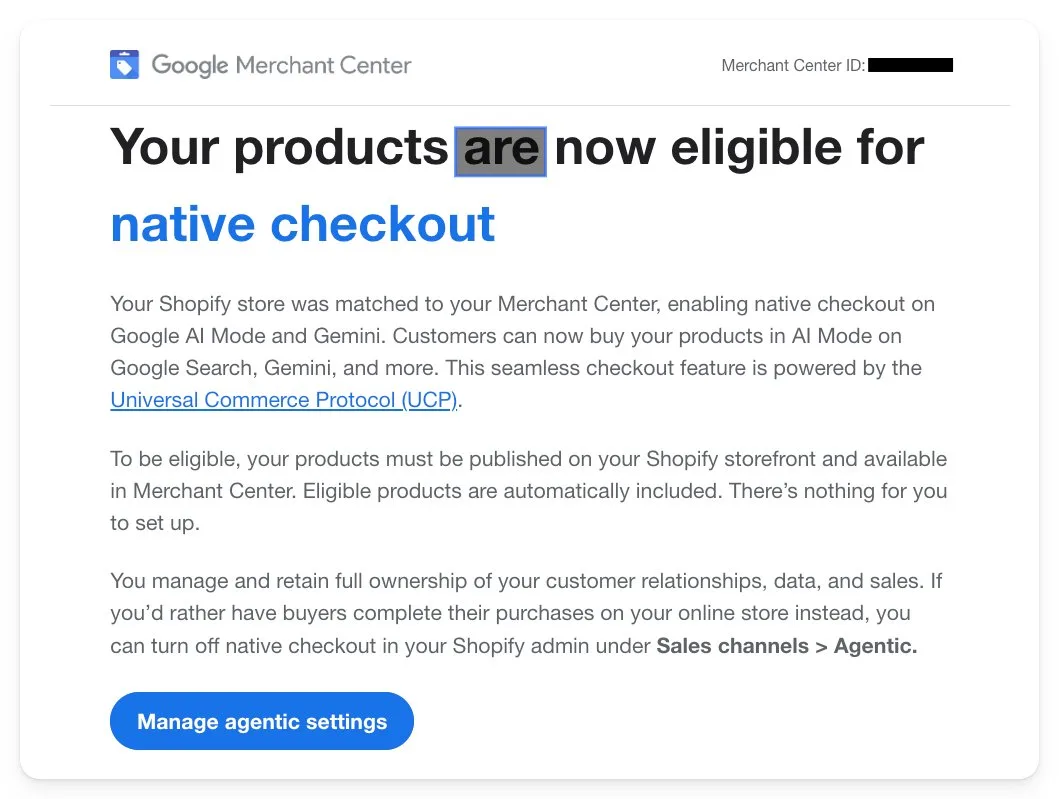
Search Engine Roundtable reported the emails on Sep 22, 2026, after Menachem Ani posted one he had received on X.
What changed
UCP-powered checkout launched in February for a limited set of merchants. Google announced the UCP integration in January.
On the Friday before the report, Google opened it to more retailers.
The email Ani shared says: "Eligible products are automatically included. There's nothing for you to set up."
Eligibility, per that email: your products are published on your Shopify storefront and available in Merchant Center. Shopify has UCP built in, so once your store is matched to Merchant Center it qualifies.
To opt out, Google sends merchants to the Shopify admin: Sales channels > Agentic.
The email in the report is the Shopify version. The source says the notices go to merchants on any platform that supports UCP, and it does not list which other platforms those are.
Why the default matters
Much of the market had read agentic checkout as stalled this year. Many brands planned around a simple split: shoppers discover in AI, then buy on the brand's site. That plan assumed a merchant would have to opt in. Google has made it opt-out.
When the purchase happens inside AI Mode or Gemini, the product page visit never happens. Neither does anything that runs on that page: cross-sells, bundles, email capture, loyalty sign-up, your own analytics tag.
Google's message says "You manage and retain full ownership of your customer relationships, data, and sales." The source does not say which customer data reaches the merchant after a native checkout, how those orders are attributed in Shopify or Merchant Center, or whether a fee applies. Until Google documents that, treat the ownership line as Google's framing. Then look at what your first native orders actually contain.
What to do today
Open your Shopify admin, go to Sales channels, then Agentic, and check whether native checkout is on.
Make the call on purpose. If your margin depends on add-ons or post-purchase flows, protecting the on-site path may be worth more. If your site adds little to a simple purchase, one more place to buy, right inside AI answers, may be the better trade.
If you leave it on, track those orders separately from site orders so you can compare basket size and repeat rate.
Frequently asked questions
Is Google native checkout on by default?+
Yes, for eligible products. Google's email to Shopify merchants says eligible products are automatically included and that there is nothing to set up. Merchants who want buyers to finish the purchase on their own site have to turn it off.
How do I turn off native checkout on Google?+
Google says to switch it off in your Shopify admin under Sales channels > Agentic.
Which merchants are eligible?+
According to the email reported by Search Engine Roundtable, your products must be published on your Shopify storefront and available in Merchant Center. Shopify has UCP built in. The source says merchants on other platforms that support UCP get the notices too, but it does not name those platforms.
Where can shoppers buy through native checkout?+
In AI Mode on Google Search and in Gemini, paying with Google Pay. Google's email also says "and more" without naming anything else.
Do merchants keep the customer data from native checkout orders?+
Google says merchants retain full ownership of their customer relationships, data and sales. The source does not say which data fields the merchant receives, so check what your first native orders actually contain.
Is this new?+
Only partly. UCP-powered checkout launched in February for a limited set of merchants. What is new is that Google has opened it to more retailers and is turning it on automatically.
Which brands does ChatGPT name for your buyers' questions?
Explore with AI
[ Keep exploring ]

Co-founder & Head of AI Innovation, Index Lab
Guilherme co-founded Index Lab, an AEO/GEO agency that makes brands the answer AI gives across ChatGPT, Gemini and Perplexity, taking clients from zero AI visibility to top recommendations.
[ Related reading ]
ChatGPT Ads Update: Sponsored Agents, Shopify and HubSpot, and Conversion Optimization Billed on Impressions
OpenAI's mid-September 2026 wave adds Sponsored Agents in a US test, Shopify and HubSpot integrations, AI help writing ads, opt-in text customization and translation, oCPM, adjustable attribution windows, app and web platform targeting, and an event quality check.
Read →NewsChatGPT Ads Opens to the UAE, Saudi Arabia, Israel and Turkey
OpenAI's Ads Manager availability table now lists 56 countries. The four new ones are the United Arab Emirates, Saudi Arabia, Israel and Turkey, and ads are expanding to users across nine markets in the Middle East, North Africa and Turkey.
Read →NewsChatGPT Ads Update: an Ads Manager Plugin, Looser Custom Audiences, and a Euro Minimum
OpenAI's 4 September product email adds a plugin that builds campaigns from ChatGPT or Codex, loosens custom audiences, widens conversion matching, reports carousel cards and paces total budgets. The same week its Help Center quietly published a 15 EUR daily minimum.
Read →See where your brand stands in AI.
Free visibility check →