
Google's Universal Cart moves checkout into Search and Gemini
The cart holds items from several retailers and can take payment through Google Pay. Merchants stay seller of record, but the visit to the product page is now optional.
Guilherme Hortinha · 15 October 2026
Can your business run ChatGPT Ads? Check in 10 seconds.
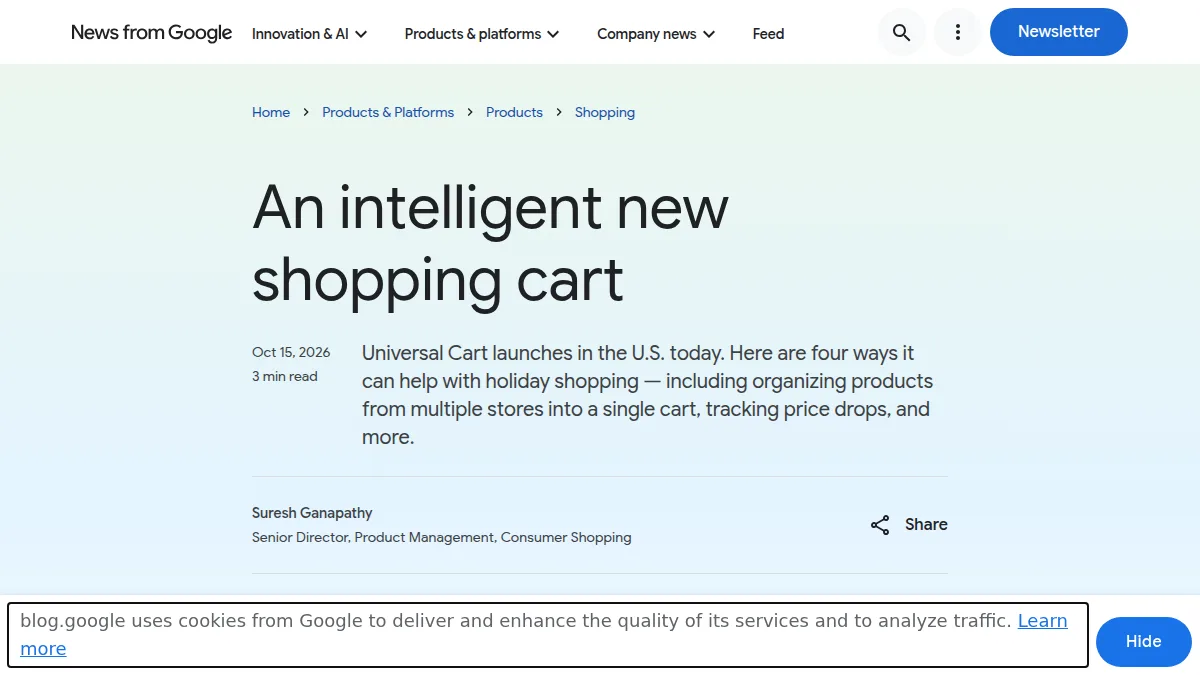
Google's Universal Cart went live in the U.S. on 15 October, across Google Search and the Gemini app. Shoppers can save products from several retailers into one cart, get alerts when prices drop or items come back in stock, see promo codes, and pay through Google Pay without leaving Google.
The market has long expected product feeds to become a sales channel of their own. This is that shift in a live product. Shoppers used to land on your product page and browse. That step is now optional.
What Google says it does
Saves items from multiple retailers in one cart that carries across AI Mode in Search and the Gemini app.
Sends price-drop and restock notifications, drawing on the 60+ billion product listings in Google's Shopping Graph.
Reads the shopper's card perks through Google Wallet, suggests which payment method to use, and shows relevant promo codes.
Lets shoppers check out with Google Pay "in just a few taps" at many stores, or send the items to the merchant's own cart.
Runs checkout on the Universal Commerce Protocol (UCP).
Google names Nike, Sephora, Target, Ulta Beauty, Walmart, Wayfair and "many Shopify merchants" as checkout partners.
What merchants keep
Google says the merchant stays the seller of record and sends confirmations and customer support directly. On paper, you keep the customer relationship. What you lose is the visit. A shopper who pays inside the cart may never see your product page, your cross-sells or your email capture.
Your listing is the shelf
The cart runs on Shopping Graph data. The price alert, the stock alert and the product the shopper sees all come from your listing. If your price, availability or description is stale or thin there, that weaker version of your product is the one competing in the cart. For these shoppers, your product data does the job your product page used to do. Give it the same care.
What the announcement does not say
How a merchant qualifies for Google Pay checkout inside the cart, or whether it is opt-in.
Whether Google takes a fee on purchases made in the cart.
What reporting merchants get on items saved, alerted or bought through the cart.
Whether or when it will launch outside the U.S.
Until Google answers those, the one thing you control is the quality of the data the cart reads.
Frequently asked questions
Where is Google's Universal Cart available?+
Google says it is rolling out in the U.S. across Google Search, including AI Mode, and in the Gemini app. The announcement gives no date for other countries.
Does checkout always happen on Google?+
No. Shoppers can pay with Google Pay inside the cart at many stores, or send the items to the merchant's own cart and finish buying on the merchant's site.
Who is the seller of record when a shopper pays through the cart?+
The merchant. Google says merchants stay the seller of record and send confirmations and customer support directly.
Which merchants support checkout in the cart?+
Google names Nike, Sephora, Target, Ulta Beauty, Walmart, Wayfair and many Shopify merchants. It does not explain how other merchants qualify.
Where does the cart get its product information?+
From Google's Shopping Graph, which Google says holds 60+ billion continually refreshed product listings. Price and stock alerts are based on that data, so the accuracy of your listing decides what shoppers see.
Which brands does ChatGPT name for your buyers' questions?
Explore with AI
[ Keep exploring ]

Co-founder & Head of AI Innovation, Index Lab
Guilherme co-founded Index Lab, an AEO/GEO agency that makes brands the answer AI gives across ChatGPT, Gemini and Perplexity, taking clients from zero AI visibility to top recommendations.
[ Related reading ]
Rank trackers may be undercounting AI Overviews, Nozzle analysis finds
Nozzle says Google has served altered results pages to some automated searches since September 20th. Those pages show AI Overviews 34.9% of the time, against 54.2% in its baseline.
Read →NewsChatGPT clicks are landing in direct traffic after GPT-6 dropped UTM tags and referrers
Since GPT-6, ChatGPT links reach websites with no UTM tag and no referrer. Page-level data from one analyst shows direct traffic picking up most of the visits ChatGPT appears to lose.
Read →NewsShopify opens its catalog to any AI agent, and shopper rules now pick the shortlist
Shoppers can connect any agent to their Shop account and buy from over a billion listings with Shop Pay. Budget and shipping rules filter products before a human sees them.
Read →See where your brand stands in AI.
Free visibility check →