
Google moves Search to Gemini 4 Hydrogen worldwide, with no figures on what changes
Google calls Hydrogen the biggest model upgrade to Search yet. It promises broader linking and more visual answers without publishing a single figure, so treat 12 November as a break in your AI visibility baseline.
Guilherme Hortinha · 12 November 2026
Can your business run ChatGPT Ads? Check in 10 seconds.
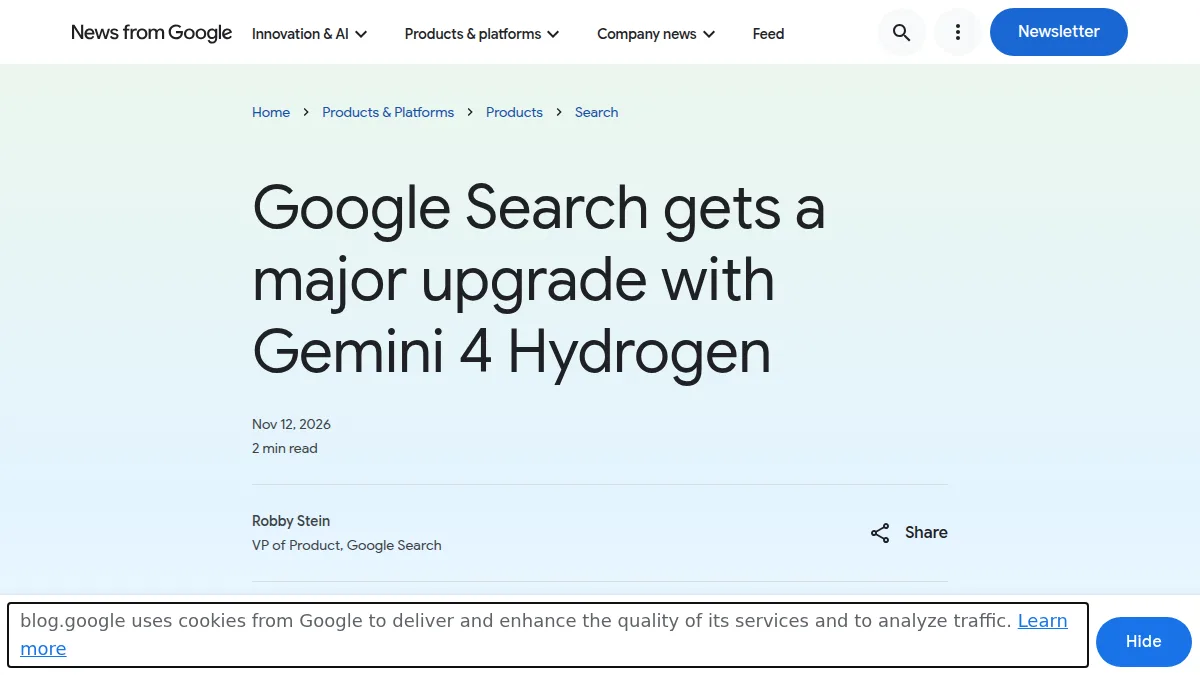
Google has rolled out Gemini 4 Hydrogen to Google Search for all users globally. Robby Stein, VP of Product for Google Search, calls it "the biggest model upgrade to Search yet" in the announcement on Google's blog, dated 12 November 2026.
What Google says changed
Intent. Search handles multi-part questions, typos and highly specific requests, with deeper instruction following and tool calling.
Query fan-out. Hydrogen runs simultaneous queries across the subtopics of a question. Google says this connects people to "a broader range of helpful links than before" and to sites they "previously might not have discovered".
Visual answers. More images, structured responses, comparison tables and custom tools.
Language. More nuanced responses across all supported AI Mode languages.
What the announcement does not say
Google gives no figure for any of these claims. It does not say how many more links appear, what share of answers now carry tables or images, or whether the way citations are selected has changed.
The post also leaves open which surfaces run the model. It says Hydrogen is in Google Search for all users, then describes the language gains in terms of AI Mode. It does not say whether AI Overviews switched at the same time. It does not define a "custom tool" either.
Why this matters for visibility tracking
A model swap breaks any AI visibility series for Google. If your brand's mentions or citations in Google's AI answers moved after 12 November, assume the model change caused it first. Look at your own content or your competitors only after that. Mark the date in your reporting so a later month-on-month comparison does not blend two models.
The broader fan-out is the change most likely to shift who gets cited. More subqueries give a page that answers one narrow subtopic well more chances to appear. It will also tempt some sites to publish a page for every variation of a question. Google's own AI optimization guide, published in May 2026, says that creating separate content for fan-out queries mainly to manipulate generative AI responses violates its scaled content abuse policy. The guide rewards original, first-hand material.
The visual shift matters most to anyone selling products. If answers carry more comparison tables, the facts that fill them have to be easy to read off your pages. Check now that your specifications, prices and structured data are clear and current.
Frequently asked questions
Is Gemini 4 Hydrogen available in every country?+
Google says Hydrogen is now available globally in Google Search for all users.
Has Google published data on how Hydrogen changes citations?+
No. The announcement says fan-out connects people to a broader range of helpful links and surfaces more images and comparison tables, but gives no figures and does not say whether citation selection itself changed.
Does Hydrogen power AI Overviews as well as AI Mode?+
The announcement does not say. It describes Hydrogen as live in Google Search for all users and frames the language improvements around supported AI Mode languages, without naming AI Overviews.
Should I create a page for every fan-out subquery?+
Google's May 2026 AI optimization guide says creating separate content for fan-out queries mainly to manipulate generative AI responses violates its scaled content abuse policy. It favours original, first-hand content.
Which brands does ChatGPT name for your buyers' questions?
Explore with AI
[ Keep exploring ]
Terms in this article

Co-founder & Head of AI Innovation, Index Lab
Guilherme co-founded Index Lab, an AEO/GEO agency that makes brands the answer AI gives across ChatGPT, Gemini and Perplexity, taking clients from zero AI visibility to top recommendations.
[ Related reading ]
Anthropic's new Claude policy bans fake site networks built to sway AI answers
Claude's rewritten Usage Policy now names search engines and AI answers as targets of manipulation. The rule is about deception. It does not cover optimisation, and it reaches the vendors who sell fake site networks.
Read →NewsGoogle says Search and AI Mode are now one product, and agents come next
On its Q3 2026 earnings call Google described AI Overviews, AI Mode and traditional Search as one product, and launched a platform that lets agents use a business's app from inside Search.
Read →NewsOpenAI says ChatGPT now handles 20 percent of Google's search volume, by its own definition
OpenAI counts only queries that trigger a web search and did not say where its Google figure came from. Those are also the queries where brands get cited.
Read →See where your brand stands in AI.
Free visibility check →