
Listicles still dominate Google's top 10, but the winners keep turning over
New research on 3,000 ranking listicles finds the format never left. What changed is which URL wins, and what makes one listicle outrank another.
Guilherme Hortinha · 4 September 2026
Can your business run ChatGPT Ads? Check in 10 seconds.
Google's push against formulaic, low-value content made it easy to assume listicles were on their way out. New research from Search Engine Land, crawling 3,000 currently ranking listicles, says otherwise: at least one true listicle still appears in the top 10 for 55.1% of the 60,000 queries analyzed, and in the top 3 for 32.3%. What actually shifted is who wins. Only 52.5% of queries kept the same position-one listicle between January and August 2026. The format held its ground. The URLs behind it didn't.
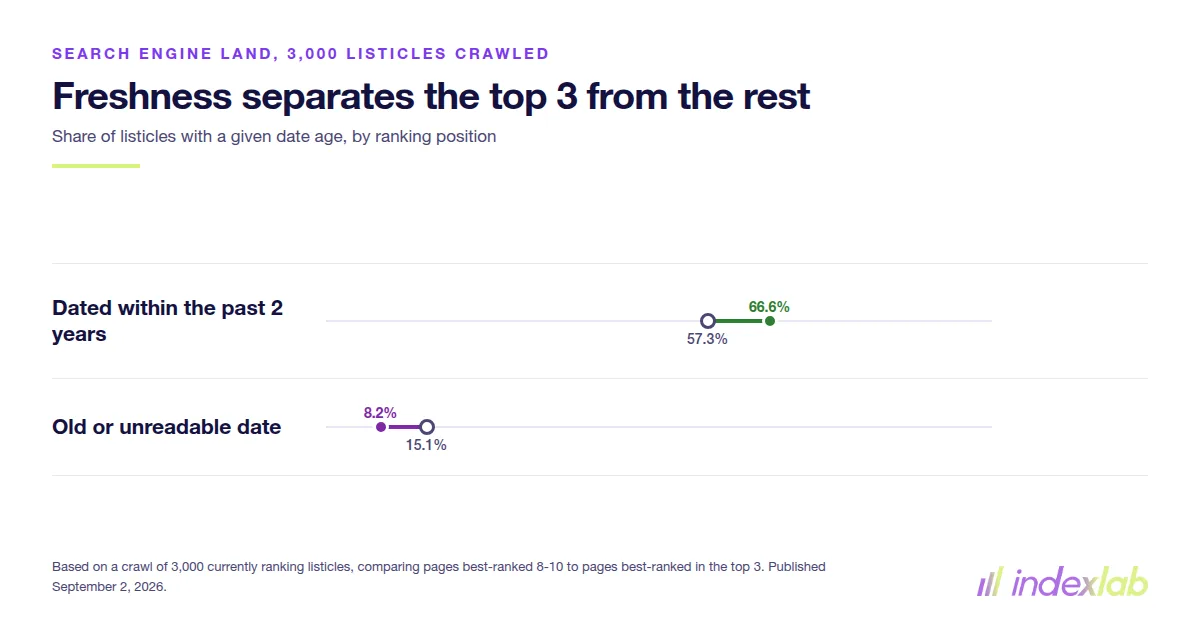
What separates a top-3 listicle
Freshness is the strongest signal. A date from the past two years appeared on 66.6% of top-3 pages versus 57.3% of pages ranked 8 to 10. An old or unreadable date showed up on 15.1% of pages ranked 8-10 versus just 8.2% of top-3 pages, and was linked to 56% lower odds of a top-3 ranking after controlling for vertical and query wording.
Counted listicles beat editorial roundups. A page with an explicit number in the title, like "17 Best Project Management Tools," won 56.8% of the 6,114 direct matchups against roundups with no number. Counted listicles landed in the top 3 55.9% of the time versus 41.4% for roundups, and averaged a best position of 3.77 versus 4.59.
More headings didn't help. A one-standard-deviation increase in heading count was associated with 29% lower odds of ranking in the top 3.
Self-promotion still pays, statistically
Vendor listicles that put their own product first grew traffic 3.5x faster than the rest of the sample, and 90.4% of self-promoting pages gained traffic against a 67.3% benchmark for others. But once the analysis controlled for starting traffic, industry, listicle type and repeat publishers, that advantage shrank to a statistically meaningless 4%, with a p-value of 0.91. The growth tracks with companies investing more effort in listicles now that they matter for AI search, not with self-promotion itself working.
Frequently asked questions
Did Google demote listicles?+
Not universally. The research found only 52.5% of queries kept the same position-one listicle URL between January and August 2026, which reads as churn in who ranks rather than a drop in how often the format appears.
What's the difference between a counted listicle and an editorial roundup?+
A counted listicle carries an explicit item count or numbered-list evidence in its title or snippet, such as '17 Best Project Management Tools.' An editorial roundup recommends several options without stating a number.
Does putting your own product first in a listicle help?+
It correlates with faster traffic growth (3.5x), but the advantage drops to a statistically insignificant 4% once starting traffic, industry and listicle type are controlled for.
Does adding more sections or headings help a listicle rank?+
No. A one-standard-deviation increase in heading count was associated with 29% lower odds of ranking in the top 3.
Which brands does ChatGPT name for your buyers' questions?
Explore with AI
[ Keep exploring ]

Co-founder & Head of AI Innovation, Index Lab
Guilherme co-founded Index Lab, an AEO/GEO agency that makes brands the answer AI gives across ChatGPT, Gemini and Perplexity, taking clients from zero AI visibility to top recommendations.
[ Related reading ]
Google's Universal Cart moves checkout into Search and Gemini
The cart holds items from several retailers and can take payment through Google Pay. Merchants stay seller of record, but the visit to the product page is now optional.
Read →NewsRank trackers may be undercounting AI Overviews, Nozzle analysis finds
Nozzle says Google has served altered results pages to some automated searches since September 20th. Those pages show AI Overviews 34.9% of the time, against 54.2% in its baseline.
Read →NewsChatGPT clicks are landing in direct traffic after GPT-6 dropped UTM tags and referrers
Since GPT-6, ChatGPT links reach websites with no UTM tag and no referrer. Page-level data from one analyst shows direct traffic picking up most of the visits ChatGPT appears to lose.
Read →See where your brand stands in AI.
Free visibility check →