Google AI Mode picks different sellers than the shopping carousel
New tracking data finds AI Mode overlaps with Google's own product carousel only 1.28% of the time, and swaps in a different top seller for 49.6% of the matches it does find.
Guilherme Hortinha · 4 September 2026
Can your business run ChatGPT Ads? Check in 10 seconds.
New tracking data from Productrise finds Google's AI Mode almost never mirrors the Popular products carousel in regular search results, even for the same query on the same day.
Productrise, which sells organic product tracking for Google Shopping, monitored more than 2 million product listings across over 100,000 searches in the US and UK from August 9 to August 31, 2026. It ran the same product searches in AI Mode and regular search on the same day and matched products using Google's product ID.
What overlapped, and what didn't
Only 1.28% of carousel listings with a Google product ID also showed up in AI Mode for the same query and day, a daily rate averaged across the 23-day window.
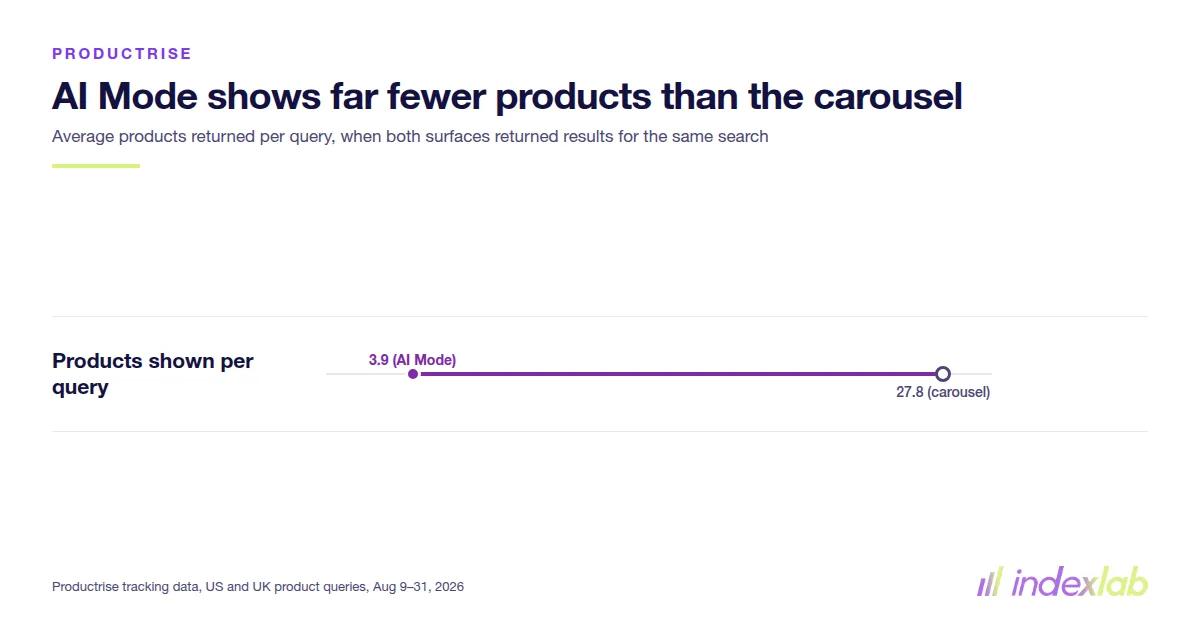
When a query returned results in both places, the carousel displayed an average of 27.8 products against 3.9 in AI Mode.
Among products that appeared in both, the first-listed seller was different 49.6% of the time, and the price was different 38.1% of the time.
Where prices differed, AI Mode showed the higher one 68.4% of the time. Across all matched products, AI Mode prices ran 21.6% higher on average.
Google told Futurism it hasn't verified Productrise's numbers. It said both surfaces pull from "the same data source: our Shopping Graph," and that shoppers can click into a listing to compare sellers themselves.
Why it matters for sellers who can't win on price
The data doesn't explain why AI Mode and the carousel disagree this often, but Productrise founder Hugo Huijer's read is that "the cheapest price is less of a factor in AI Mode." If that holds, ranking well in the standard Shopping carousel on price gives no guarantee of showing up in AI Mode. A seller with a stronger product feed but a higher price has a real shot at being picked there instead. That opens a lane for small sellers who can't out-discount bigger competitors on price alone. Huijer's theory hasn't been tested against click or purchase data, so it stays a theory.
The practical move is Huijer's own: search your top items in both regular search and AI Mode, and check who is listed first, and at what price.
Frequently asked questions
Has Google verified this data?+
No. Google told Futurism it hasn't verified the accuracy of Productrise's report, while saying both AI Mode and regular search draw on the same Shopping Graph.
Can a shopper see other sellers for a product inside AI Mode?+
Yes. Clicking a product in either AI Mode or the carousel opens a panel showing other sellers and prices, so the first-listed offer is only one of several.
Which brands does ChatGPT name for your buyers' questions?
Explore with AI
[ Keep exploring ]

Co-founder & Head of AI Innovation, Index Lab
Guilherme co-founded Index Lab, an AEO/GEO agency that makes brands the answer AI gives across ChatGPT, Gemini and Perplexity, taking clients from zero AI visibility to top recommendations.
[ Related reading ]
Product pages beat Reddit for AI citations, but the data is B2B only
Ten Speed's study found product pages draw 24.1% of AI citations against 4.2% for Reddit, YouTube and forums combined, and the number survived six fact-check questions. The dataset behind it is B2B SaaS and professional services clients only.
Read →NewsOrganic search still sends more traffic than AI platforms combined, Shopify data shows
A Search Engine Land outlook on 2027 SEO cites Shopify's Q2 analysis: AI-referred storefront sessions grew 197% year over year, but organic search stayed bigger and grew 12% on its own larger base.
Read →NewsGoogle's John Mueller calls the daily-crawl sitemap trick a bad idea
A technique that appends a changing timestamp to sitemap URLs to force daily recrawling gets a warning from Google's search advocate, because it destabilizes the canonical URL a page needs to be tracked and cited.
Read →See where your brand stands in AI.
Free visibility check →