OpenAI puts paid display ads next to ChatGPT image generation results
OpenAI will test ads beside ChatGPT image generation for Free and Go users in the US from later in October. The same announcement named its measurement partners and opened Negative Phrases to qualifying advertisers.
Guilherme Hortinha · 6 October 2026 · Updated 2 November 2026
Can your business run ChatGPT Ads? Check in 10 seconds.
OpenAI will test visual ads next to the images people ask ChatGPT to generate, it announced on 5 October 2026. Testing starts later in October in the US with an initial group of advertisers, and the ads reach users on the Free and Go plans. The same announcement named the first measurement partners for ChatGPT Ads and opened Negative Phrases, a placement exclusion, to qualifying advertisers.
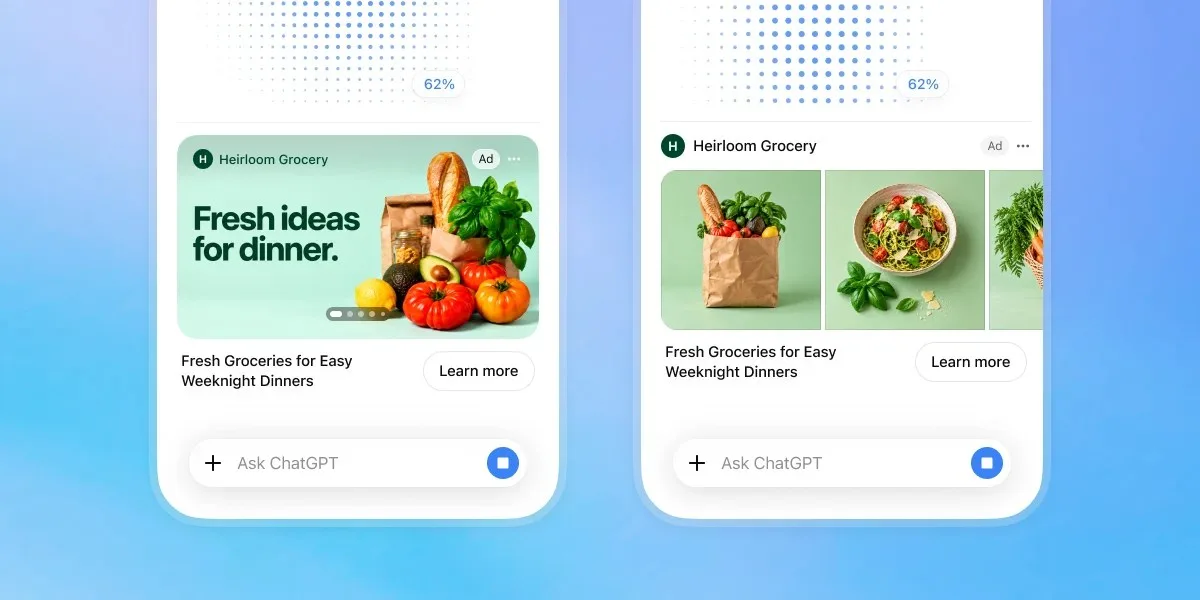
Update, 2 November 2026: the test is running. OpenAI's help centre now says users may see an ad with several images from one advertiser while ChatGPT generates their image, gone once the image is finished. Separately, since 26 October every advertiser can build a standard ad with four to six square images in open beta, and since 30 October the standard card is wider on desktop: multi-image ads and the wider card.
Update, 12 October 2026: OpenAI's own announcement and Ads Blog post add the Free and Go limit, Negative Phrases, three data integrations, brand-lift testing and the first partner results.
What was announced
Visual ads will be tested during image generation, shown to users on the Free and Go plans. They are clearly labelled and kept separate from the image being created, and OpenAI says advertising does not influence the answers ChatGPT provides.
Testing starts later in October in the US, with an initial group of advertisers.
Conversion data integrations: Hightouch, Tealium and LiveRamp.
Click attribution, reporting and Conversions API partners: AppsFlyer, Triple Whale, Adjust, DV Rockerbox, Northbeam, Branch, Singular, Kochava, Airbridge and Tenjin.
Full-funnel measurement partners: Fospha, Measured and INCRMNTAL.
Geo-based incrementality experiments with Haus, Measured and WorkMagic, which OpenAI calls early-stage.
Brand-lift testing with Kantar and Cint, also early-stage.
Negative Phrases, now available to qualifying advertisers, for placement requirements specific to a brand's own policies.
Brand suitability evaluation pilots with DoubleVerify and Integral Ad Science, run in a controlled test environment without access to private conversations.
A surface you can only buy
Most AI visibility work goes into text answers: getting a brand cited, named or recommended. Image prompts have nothing like that. When someone asks ChatGPT for a picture, they get a newly generated image. There are no sources and no brand list for you to earn a place in. As far as we can see, that makes the ad slot beside it the first ChatGPT surface where the only way for a brand to appear is to pay for it.
This splits the work for a marketing team. Text answers stay an organic channel that you shape with content and citations. Image results are a media buy, so plan and measure them like one.
The partner list is the tell
The test is small, and the measurement setup around it is large. It includes the attribution vendors that performance teams already run, incrementality and geo testing, brand-lift studies, and the brand safety verifiers that large advertisers expect before they commit budget. OpenAI is building what it needs to sell this at volume. It puts ChatGPT's weekly reach at 1.2 billion people and has not said when the image test widens beyond the US.
The results OpenAI published
Each figure comes from one partner measuring one advertiser:
DV Rockerbox: WeightWatchers' attributed cost per acquisition on ChatGPT Ads was 15.3% below its blended paid-search benchmark.
WorkMagic: a geo-lift study for the wellness brand Dose estimated 2.3 times more incremental orders than last-click attribution captured, with 67% of incremental purchases coming from net-new customers.
Triple Whale: 93% of Portland Leather's visitors from ChatGPT Ads were new.
OpenAI's own early analysis: 52.7% of eligible one-day view-through conversions happened within an hour of the ad impression.
The last number matters most for anyone reporting on this channel. OpenAI says people often act after seeing an ad without clicking it, so a report that counts clicks alone misses part of the result. Keep the one-day view window on.
Negative Phrases
Negative Phrases give a brand a way to keep its ads out of specific conversations. In the accounts where the setting has appeared, it sits under Settings and takes up to 100 phrases of up to 100 characters each, and an ad does not show when the user's message contains one. OpenAI offers it to qualifying advertisers and has not published who qualifies. It sits on top of OpenAI's own placement guardrails, which already keep ads away from emotionally vulnerable and sensitive conversations. Where an ad does show is still decided by its context hints.
What we do not know
How the image ads are targeted, and whether the image prompt itself decides which ad appears.
Pricing, how advertisers buy the format, and when the test widens beyond the US.
Which advertisers qualify for Negative Phrases.
What to do
If you sell in a visual category, check whether your current attribution vendor is on the list. If it is, measuring a test will need very little new setup. Plan image placements as paid inventory with their own budget line, kept separate from your organic AI visibility work. If there are conversations your brand must never appear beside, look for Negative Phrases under Settings in Ads Manager. Every partner and what it measures is in our ChatGPT ads measurement guide, and each platform change is dated on the availability page.
Frequently asked questions
Where do the new ChatGPT visual ads appear?+
During image generation in ChatGPT, beside the image a user asked for, for users on the Free and Go plans. OpenAI says the ads are clearly labelled and kept separate from the image being created.
When and where do the ads launch?+
Testing began in the US in late October 2026 with an initial group of advertisers. OpenAI has not given a date for other markets or for self-serve access.
Can a brand appear in ChatGPT image results without paying?+
Not in any route we can see. A generated image has no citations or brand list to earn a place in, so the ad slot is the only way to be visible there.
Do the ads change what ChatGPT generates?+
OpenAI says advertising does not influence the answers ChatGPT provides, and that the image ads remain separate from the image being created.
Which measurement partners can advertisers use?+
Hightouch, Tealium and LiveRamp for sending conversion data; AppsFlyer, Triple Whale, Adjust, DV Rockerbox, Northbeam, Branch, Singular, Kochava, Airbridge and Tenjin for click attribution, reporting and the Conversions API; Fospha, Measured and INCRMNTAL for full-funnel measurement; Haus, Measured and WorkMagic for geo-based experiments; and Kantar and Cint for early brand-lift testing.
What are Negative Phrases in ChatGPT Ads?+
A placement exclusion OpenAI made available to qualifying advertisers on 5 October 2026. In the accounts where it has appeared, an advertiser lists up to 100 phrases of up to 100 characters each under Settings, and an ad does not show when the user's message contains one.
Which brands does ChatGPT name for your buyers' questions?
Explore with AI
[ Keep exploring ]
Terms in this article
Co-founder & Head of AI Innovation, Index Lab
Guilherme co-founded Index Lab, an AEO/GEO agency that makes brands the answer AI gives across ChatGPT, Gemini and Perplexity, taking clients from zero AI visibility to top recommendations.
[ Related reading ]
ChatGPT Business Hub opens first-party visibility data, counted by website mentions
OpenAI's new dashboard shows mentions, clicks and discovery topics from ChatGPT itself. It has no prompts, no per-article view and no competitor benchmarks, and its terms ask signups to give up certain legal claims.
Read →NewsChatGPT Business Hub counts a mention only when ChatGPT references your website
OpenAI opened Business Hub in beta with mention and click counts, the same week Google started a core update and switched AI Mode to Gemini 4 Hydrogen. Each number this week counts something different.
Read →NewsUnited lets search engines index its site and makes AI agents ask permission first
United's new terms treat search crawlers and AI agents as separate things and bar AI grounding on its fares. They do not say how United will tell an agent from a person.
Read →See where your brand stands in AI.
Free visibility check →